STATE COLLEGE, Pa. — October 11, 2026
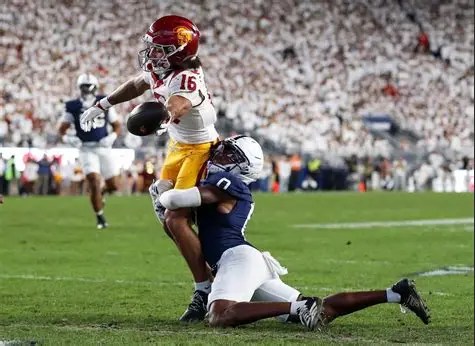
The lights were bright, the crowd was dressed in white, and Beaver Stadium was ready for a night to remember. But when the final whistle sounded Saturday night, it was No. 19 USC celebrating a statement victory, defeating Penn State 31–23 in front of a record 114,419 fans at Beaver Stadium.
The Trojans overcame one of college football’s most recognizable home-field environments, using an efficient passing attack and timely defensive execution to hand the Nittany Lions their third consecutive loss and drop Penn State to 0–3 in Big Ten play. USC improved to 6–1 overall and 3–1 in conference action. <escape>[1]</escape>
For Penn State, the White Out was supposed to provide a spark in a season that has already tested the patience of Nittany Lion fans. Instead, the evening ended with another difficult result and renewed questions about a defense that has struggled to consistently contain opposing offenses.
Maiava leads a balanced USC attack
USC quarterback Jayden Maiava delivered the kind of performance needed to win on the road in a hostile environment. The Trojans’ signal-caller completed 21 of 33 passes for 301 yards and three touchdowns without throwing an interception.
Maiava spread the ball around, connecting with Trent Mosley, Tanook Hines and Kayden Dixon-Wyatt for touchdown receptions. Mosley proved especially difficult for Penn State to contain, finishing with nine catches for 111 yards.
Running back King Miller added a rushing touchdown as USC generated 430 total yards, including 301 through the air and 129 on the ground.
The Trojans established an offensive rhythm early, scoring on their opening possession before answering Penn State’s first touchdown. They continued to find opportunities downfield, forcing the Nittany Lions to defend the full width of the field rather than concentrate solely on stopping the run.
USC’s ability to sustain drives and finish possessions with points ultimately made the difference.
Penn State fights back but cannot finish
The Nittany Lions showed more offensive aggression than in their previous conference losses, trading scores with USC throughout the first half.
Quarterback Rocco Becht completed 21 of 32 passes for 289 yards and a touchdown, giving Penn State a reliable passing option against the Trojans. Tight end Andrew Rappleyea caught a touchdown pass, while running back Carson Hansen added a rushing score. Ryan Barker contributed three field goals.
Penn State entered halftime tied 17–17, keeping the record crowd engaged and giving the home team a legitimate opportunity to take control.
The Nittany Lions briefly moved ahead in the third quarter when Barker connected on a 35-yard field goal after Penn State recovered USC’s attempted onside kick to open the half.
But the lead did not last.
USC answered with a touchdown drive capped by Miller’s 13-yard run, reclaiming the advantage and shifting the pressure back onto Penn State. The Trojans added another touchdown in the fourth quarter, while their defense made the critical plays needed to protect the lead.
Penn State finished with 357 total yards, but the offense managed only 68 rushing yards as a team. USC, meanwhile, totaled 430 yards and converted its opportunities into enough points to leave Happy Valley with the victory. <escape>[1]</escape]
The decisive defensive moment came with 3:59 remaining. USC’s Christian Pierce punched the ball away from Penn State receiver Brett Eskildsen, allowing the Trojans to regain possession and run out the clock. With the Nittany Lions unable to get the ball back, their comeback hopes ended.
Kooper Ebel and a Nittany Lion defense under pressure
For linebacker Kooper Ebel, the loss adds another challenging chapter to Penn State’s defensive struggles during the 2026 season.
The senior linebacker from Hartley, Iowa, has brought experience and production to the Nittany Lions after transferring from Iowa State. Listed at 6-foot-4 and 233 pounds, Ebel entered the season on the Butkus Award Watch List, recognition reserved for some of the nation’s top linebackers. <Cite refs={[“turn394086search12”]}/>
Ebel had been particularly active in the weeks leading up to the White Out. He recorded eight tackles against Wisconsin and matched his career high with 11 tackles against Northwestern on October 2. Through his first five starts of the season, he had totaled 29 tackles, two tackles for loss, one sack and two pass breakups. <Cite refs={[“turn394086search12”]}/>
Those performances illustrate the responsibility Ebel carries in the middle of Penn State’s defense. Linebackers must diagnose run plays, fill gaps, cover receivers and help organize a unit when opponents use motion and misdirection to create openings.
Against USC, the broader challenge was limiting an offense capable of attacking both vertically through the passing game and on the ground. The Trojans finished with 430 total yards and averaged nearly eight yards per play through the first three quarters, according to the game recap. <Cite refs={[“turn394086search8”]}/>
Ebel’s individual contribution should be distinguished from the performance of the defense as a whole. Penn State’s official postgame report identified linebacker Tony Rojas as the team’s defensive leader with 10 tackles, a forced fumble and a sack. <Cite refs={[“turn394086search11”]}/>
Ultimately, the Nittany Lions needed more stops at critical moments. USC’s ability to answer Penn State’s brief third-quarter lead and then force a late turnover demonstrated how narrow the margin can be against an efficient opponent.
For Ebel and the rest of the defensive unit, the challenge now is translating individual effort into more consistent team results.
A White Out crowd that deserved a better finish
The atmosphere in State College was worthy of the occasion. With 114,419 fans in attendance, Penn State established a new Beaver Stadium attendance record. The overwhelming majority wore white, creating the unmistakable backdrop of the program’s signature home game. <Cite refs={[“turn394086search11″,”turn394086search14”]}/>
Yet even that environment could not overcome the difference in execution during the decisive stretches.
USC handled the pressure, continued producing explosive plays and protected its fourth-quarter advantage. Penn State showed flashes of improvement offensively, but its inability to consistently stop the Trojans left the home crowd without the breakthrough it wanted.
The defeat also extended Penn State’s losing streak to three games following setbacks against Wisconsin and Northwestern. The Nittany Lions now sit at 3–3 overall and 0–3 in the Big Ten, placing additional importance on their response in the weeks ahead. <Cite refs={[“turn394086search8″,”turn394086news3”]}/>
What comes next?
USC leaves Pennsylvania with a significant conference road victory and momentum heading into its next scheduled matchup against Wisconsin on October 24. At 6–1 overall, the Trojans remain in position to build on their strong start to Big Ten play. <Cite refs={[“turn394086search8”]}/>
Penn State, meanwhile, must find answers on both sides of the football. The passing game demonstrated it can keep the Nittany Lions competitive, but improving the ground attack and limiting opponents’ scoring opportunities will be essential to reversing the team’s trajectory.
For Kooper Ebel and the defense, the focus shifts to preparation, tackling consistency and getting off the field on third down. Penn State allowed USC to dictate too many important stretches of the game, and the next opportunity will demand a more complete defensive performance.
The White Out delivered its usual spectacle, but the result belonged to the Trojans.
USC 31, Penn State 23.
In a stadium built to give the Nittany Lions an advantage, USC proved that atmosphere alone is not enough. Execution, discipline and timely plays decide games—and on Saturday night, the Trojans delivered when it mattered most.


Leave a Reply